
Eesti kunsti oksjonid
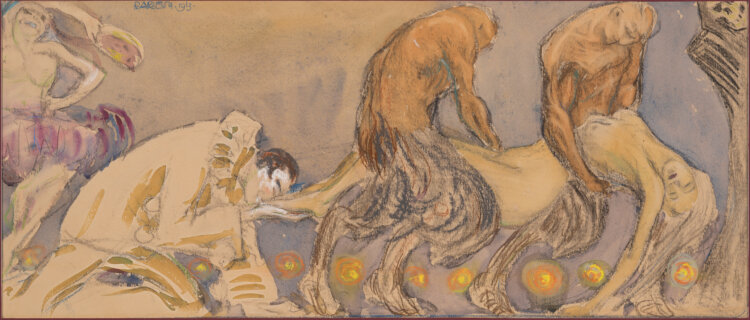
Peet Aren “Hüvastijätt”
Sügisoksjon 2024
Mixed media on paper. 1913.
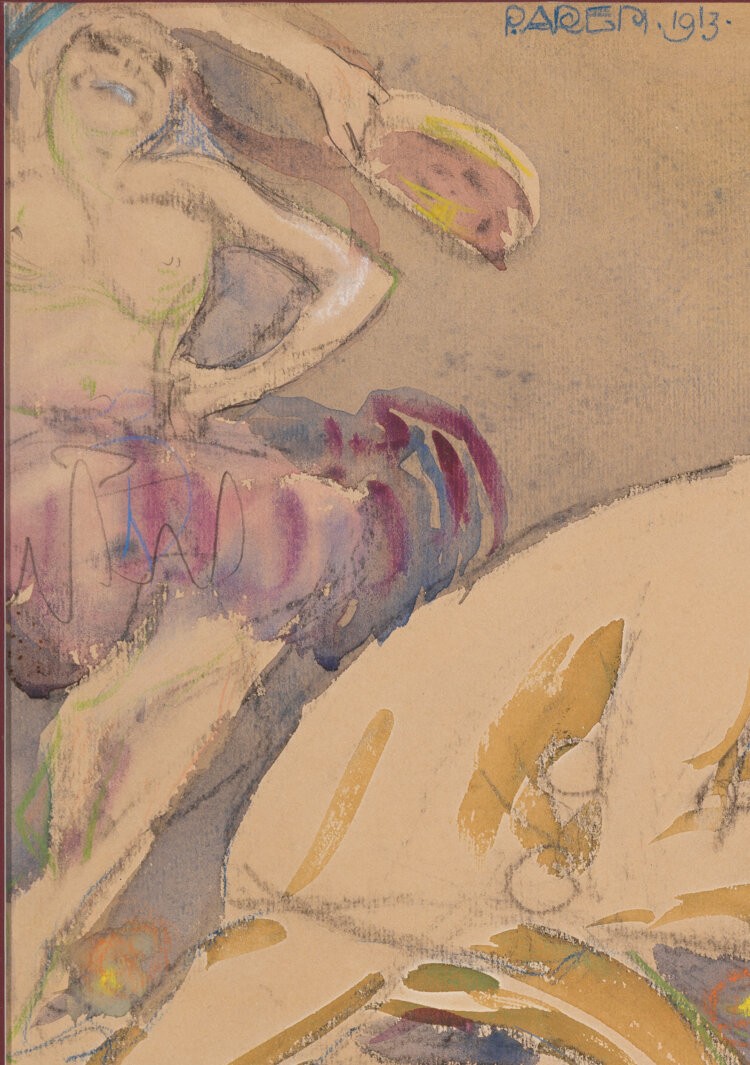
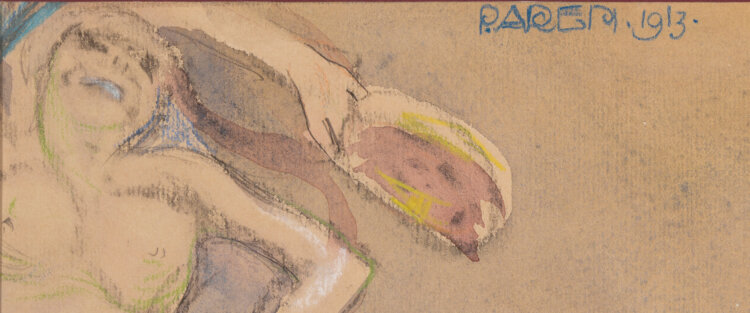
Signature: P. AREN. 1913.
The artistic ability and organizational will of Peet Aren (1889-1970), born in Viljandi County, is confirmed by the fact that although archival sources show his years of study at the St. Petersburg Society for the Promotion of Arts from 1908-13, he was already working in Tallinn, at the architectural office of Karl Burman Sr., in 1910. His figure drawings from that time stand out for their bold generalization and interest in expressive angles.
He also organized several exhibitions together with August Jansen, Karl Burman Sr. and his brother Paul: in 1912 in Narva and in 1913 in the Tallinn Stock Exchange Hall (in the Suurgild House on Pikk Street). It is very likely that “Farewell” was exhibited at the 1913 exhibition alongside his Art Nouveau portraits of his mother and sister (1912, both in the Tartu Art Museum). Namely, there were also a number of others on display at that exhibition, which unfortunately were not documented in more detail in the catalogue – a characteristic feature of older catalogues.
While working at the architectural bureau, Aren met the renowned civil engineer and statesman Karl Jürgenson, with whom they were united in addition to their professional interests in the city of their birth. Jürgenson, who later worked as an assistant to the Minister of Transport, was responsible for the development of Estonian architecture and construction for many years and, among other things, designed the Jakob Westholm Gymnasium building (now the Tallinn Art School on Kevade Street). Grieving Jürgenson who had just lost his wife due to complications during childbirth, commissioned Aren who had just completed his art studies, to create a piece in memory of his young wife in 1913.
Thus was born “Farewell”, one of the most beautiful and at the same time lesser-known works of Estonian Art Nouveau symbolism, which would have been well-suited for the exhibition “Children of the Evil Flowers. Estonian Decadent Art” organized in 2018 at Kumu. It was there that works on the themes of love and death from the early decades of the 20th century were shown.
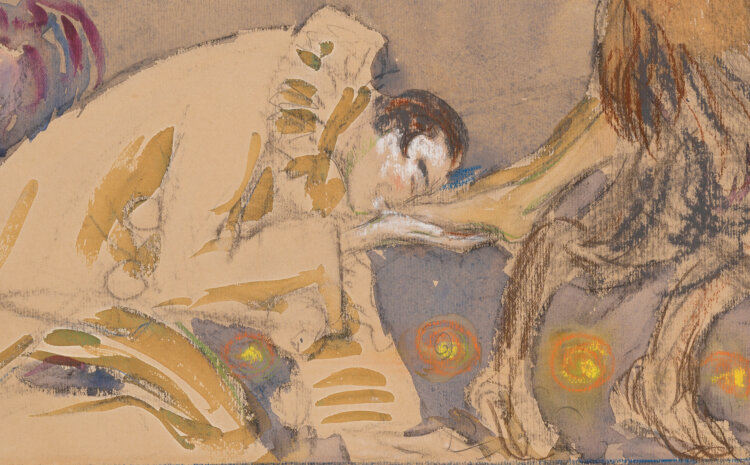
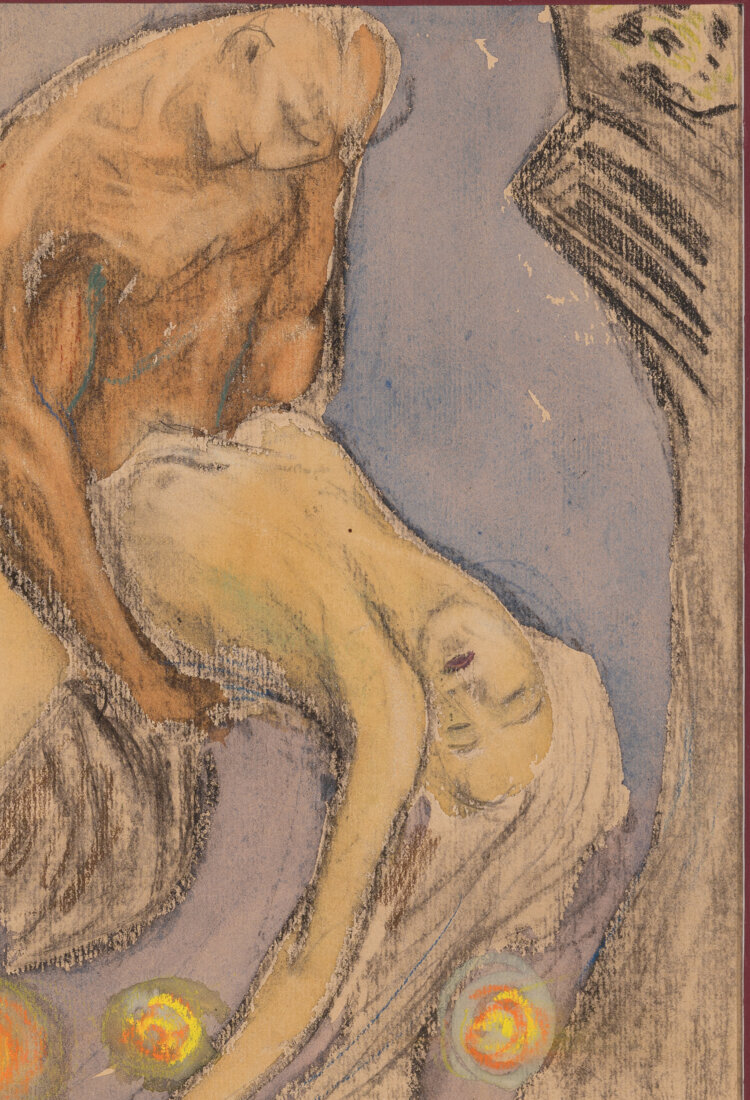
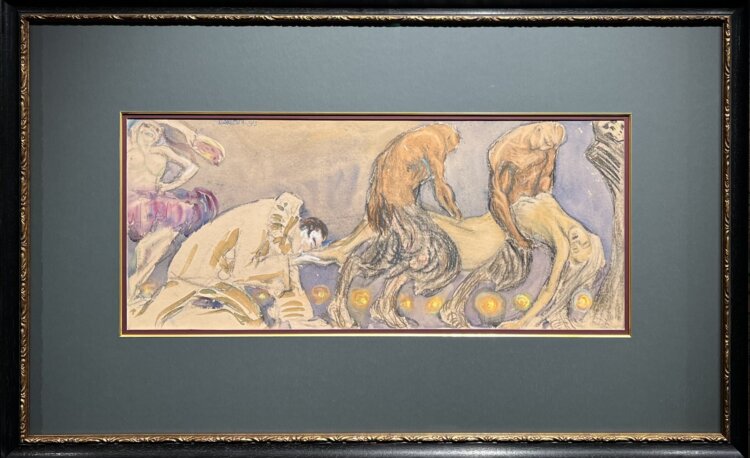
Early 20th century Nordic symbolism loved the themes of death and departure in literature, art and music but it is very rare to see such an original thematic solution in Estonian art. In Aren’s painting, pain, theatre and tragedy are intertwined like an ornamental strip: a man’s upper body and stocking-legged satyrs carry a departed beautiful woman at whose feet the inconsolable Pierrot, a man with a fan-collar, who was a frequent character in the art of the turn of the 19th and 20th centuries, bows.
The procession is preceded by a personification of death in the form of a skull, and it is ended by a dancer with a tambourine, to celebrate the beautiful moments and memories of life that the woman missed here. Thus, ancient mythology is intertwined with Aren’s contemporary perception of life and the artistic quality is equally dominated by decorative style and stylization.
The commissioner of the work, Karl Jürgenson, was arrested during World War II and killed in Solikamsk prison in 1941. Thus, the work comes to auction from the estate of his second wife, soprano Paula (Pauline) Brehm whose descendants have ensured the preservation of “Farewell” to this day.
Text: Mai Levin, Harry Liivrand, Katre Palm