Eesti kunsti oksjonid
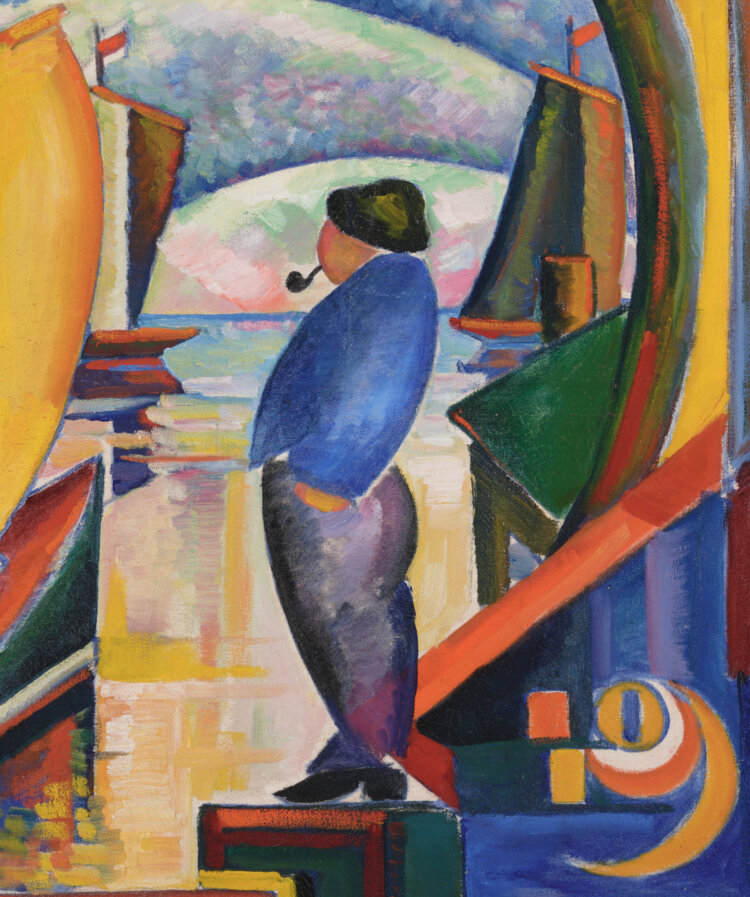
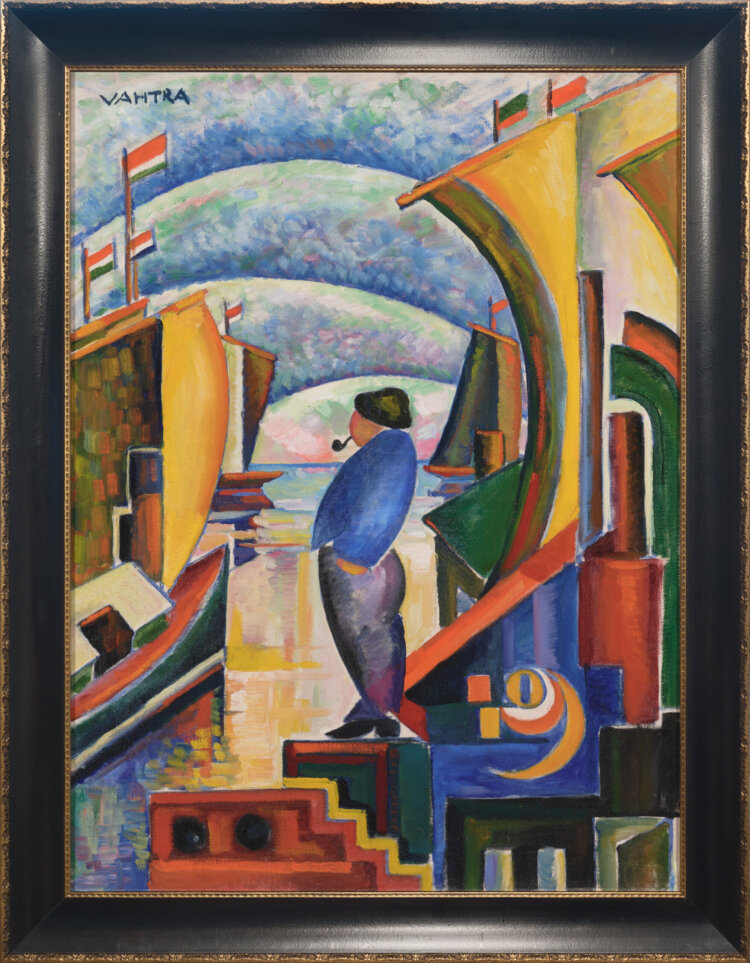
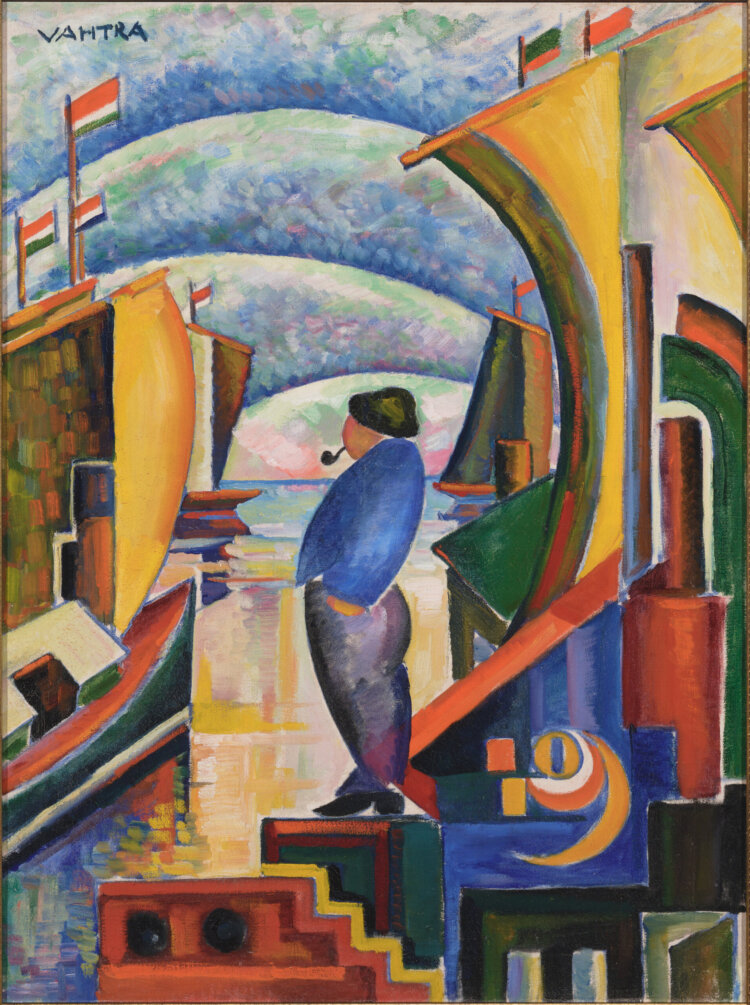
Jaan Vahtra “Sadam”
Sügisoksjon 2025
Oil on canvas. 1923
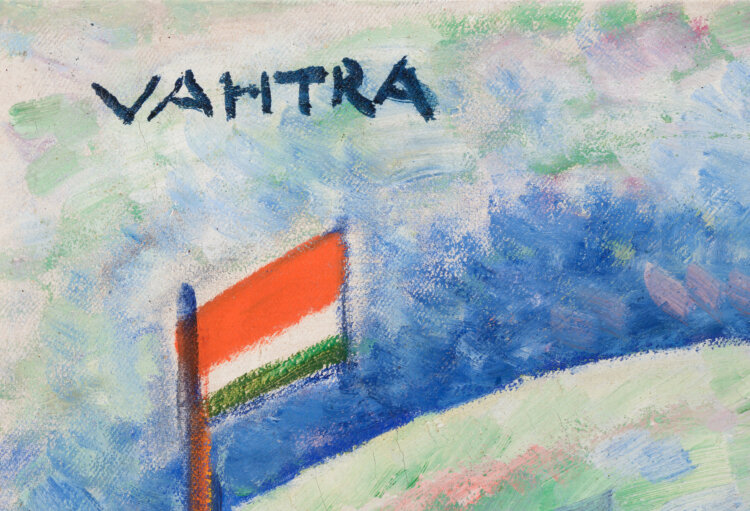
Signature: VAHTRA
“A ship with raised sails
approaches my shore.
I sense it, I feel it –
and I stand, my back sweaty.”
Excerpt from Doris Kareva’s poem “A ship with raised sails”
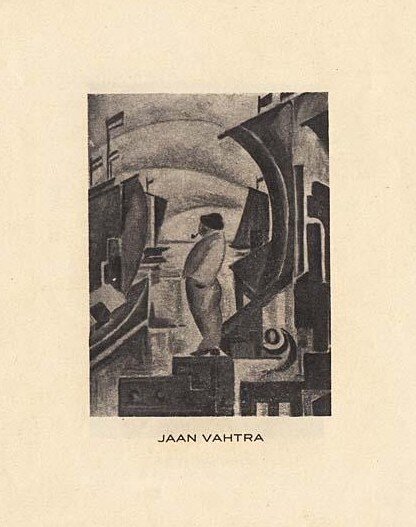
Allee Gallery has the great honor and privilege of presenting to you one of the most sought-after paintings in Estonian art history: Jaan Vahtra’s “Harbor” from 1923, which participated in Estonia’s first international exhibition in Tartu and Tallinn in 1924, organized by the then newly established Estonian Artists’ Group. Only two of Vahtra’s works are reproduced in the exhibition catalogue (there were 18 in total in the exhibition): his iconic “Self-portrait” with a pipe (1923, Art Museum of Estonia), which was acquired by the museum in 1940, and “Harbor” before us.
Liis Pählapuu has written about the importance of the activities of the Estonian Artists Group, established in 1923 – whose chairman Jaan Vahtra became in 1925 – in Estonian art life: “The Estonian Artists Group, which remained the only avant-garde group in Estonia, took the clearest direction towards modern art – a unique act of courage against the backdrop of traditionalist national pathos – initiated by a core of artists from Southern Estonia. However, the first exhibition, preparatory to the group’s activities, was not held in Tartu or Tallinn, but in Võru. The exhibition was held in Võru Kandle in February 1923 and displayed the works of Jaan Vahtra, Friedrich Hist, Eduard Ole and Ardo Sivad (Sivard), showing Võru for a few moments as the capital of the Estonian avant-garde. (“Talomuro ilmuraum” exhibition catalogue, 2021, p. 22).” A review of the exhibition mentioned: “The work of Vahtra stood out the most, but the expressive and cubist part of it “the public seems to have little idea of understanding”. Vahtra, who wrote articles and gave lectures to the public, became the main introducer and representative of modern art movements in Estonia in the following years.” (“From the Concept of Beauty in Visual Art”, Lilulii 1924).
However, something even more powerful followed – Estonia’s first international exhibition in January 1924, which was called the First Cubist Art Exhibition between the Baltic States. Initially, it was planned to include Lithuanian and Finnish cubist art as well but due to lack of money and time, Estonian and Latvian artists were ultimately excluded from the event (in addition, the managers of the Lithuanian avant-garde artist Vytautas Kairukštis were unable to find him in Warsaw, and the Finns themselves had little idea of the cubist works of Ilmari Aalto).
While other art was also included in the Võru exhibition, the Estonian-Latvian exhibition of 1924 featured only Cubism and the best of it. Most of Vahtra’s works from these two major exhibitions have disappeared and some were also destroyed by the Soviet authorities – fortunately, the purchase of “Harbor” by a private collector saved it from the latter. In total, works were purchased from the 1924 exhibition, which we can today consider one of the most significant exhibitions of the first half of the 20th century, for 46,000 marks. Among them, the work before us was the only one that went to a private collection, and was purchased for 10,000 marks by a state official and member of the government of critical importance in the history of the birth of the Republic of Estonia, who was also awarded the Order of the White Star.
Vahtra’s work in 1919-1924 was under the influence of Cubo-Futurism. Namely, he came into contact with it in St. Petersburg, studying at the School of the Society for the Promotion of Arts from 1913 to 1916 and then at the Academy of Arts. During his studies, he visited numerous exhibitions of avant-garde groups, one of the most important impetuses towards cubism and constructivism being the exhibition “Tram V” held at the St. Petersburg Academy of Arts in the winter of 1915. It was there that, among others, Vladimir Tatlin, Vassily Kandinsky and Marc Chagall were represented.
Among the artist’s surviving works, the woodcuts from the folder “Blanc et noir” (1919-1921), which were published by the artist’s own publishing house “Ellai” in Võru in 1921, and the woodcut illustrations for the monthly magazine “Ilo” no. 3, 1920 (published by the publishing house “Odamees”) and the watercolors “Still Life with an Iron” (1923) and “Still Life with a Jug” (1924) in the collection of the Tartu Art Museum, which were probably also featured in the First Exhibition of Cubists in the Baltic States.
And of course “Harbor” with its rectangular and curved forms and similar coloration as in the aforementioned watercolors. The theme of the port was popular in both our expressionist graphics and painting in the early 1920s – people often traveled by sea on their creative journeys. Among others, Märt Laarmann, who took part in the Cubist exhibition in Tallinn with his woodcuts, painted his famous “Port” (Estonian Art Museum) in 1924. While in the latter we see cranes and steamboats sailing, in Vahtra’s painting there were clear sails as if symbolizing new ideas flying by.
The composition is centered around a man with a pipe – the artist himself, who was a keen pipe-smoker. He has also depicted himself with a pipe in a self-portrait in the permanent collection of the Art Museum of Estonia and in several other works, not to mention the surviving photographs in which this accessory was always with Vahtra. Among the fluttering flags we find the Hungarian flag, which may have been inspired by the plan to strengthen Finno-Ugric relations that was on the agenda at the time. Namely, at the time the painting was completed, a large Finno-Ugric educational conference was being organized in Tallinn (held in 1924), where, among other things, it was decided to create centers coordinating Finno-Ugric communication in Finland, Hungary and Estonia.
Despite several challenges in organizing the above-mentioned exhibition, it was still done and forever written into art history. Just like “Harbor” itself, which is once again before the art public after 100 years.
Text: Katre Palm, Mai Levin