
Eesti kunsti oksjonid
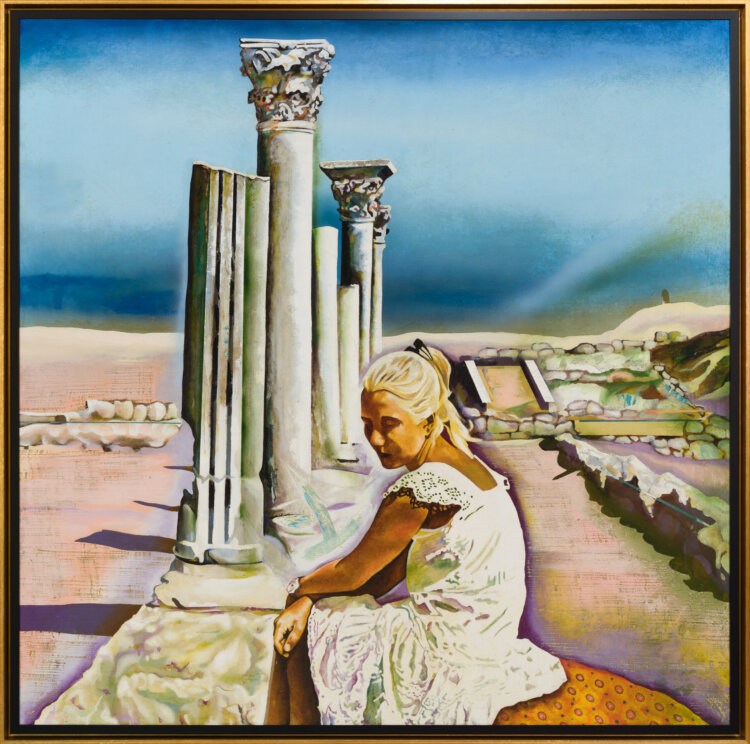
Heitti Polli “Helgi päikese all (Hersones)”
Sügisoksjon 2025
Oil on canvas. 1980.
Signature: – Helgi päikese all – Hersones – Heitti Polli 161×161 Õ. L. 1980 a.
| Measurements | 161 x 161 cm |
|---|---|
| Starting price | 24 000 € |
| Number of bids | 1 |
| Hammer price | 24 000 € |
One of the leading painters of Estonian hyperrealism, Heitti Polli was already genetically predisposed to engage in creativity – he grew up literally “with a brush in his hand” in the family of renowned artists Kaljo and Ellen Polli and began drawing and painting at an early age. The 1970s and 1980s were the heyday of his hyperrealist work, and in the year preceding this particular painting, Polli received a national scholarship from the Estonian Artists’ Youth Association. This support enabled the artist to travel and also inspired this work, born under the warm Southern sun.
In 2016, the exhibition “Cold Gaze. Variations on Hyperrealism in Estonian Art” at Kumu featured several of Polli’s paintings, and curator Anu Allas wrote in the accompanying text: “On the one hand, the photographic method of representation was a stylistic technique that allowed for playing over the realism requirements placed on art while on the other hand, the photograph became a dialogue partner and mediator of the contemporary perception of the world, which intertwined with the most diverse – conceptual, metaphysical, critical, symbolist, postmodern – directions of art at the time.”
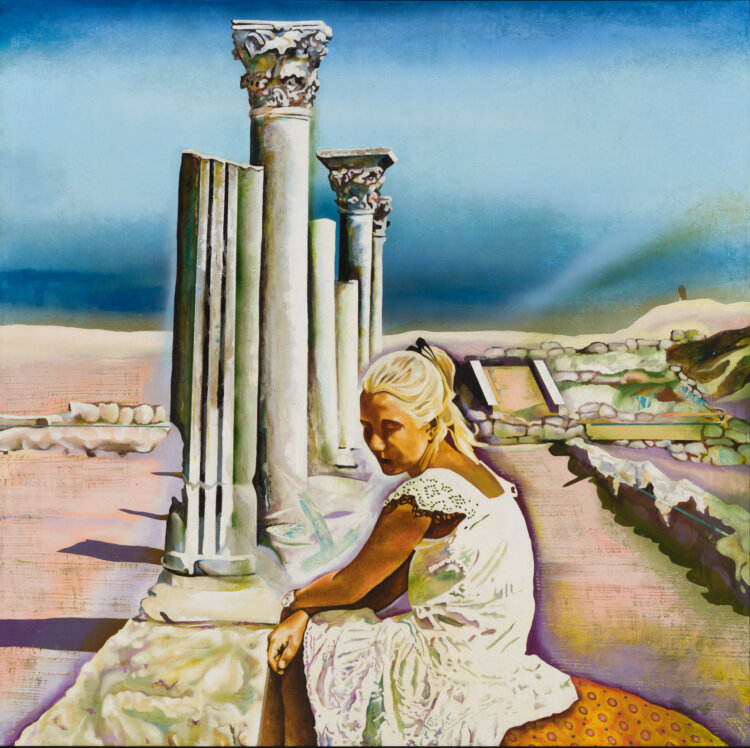
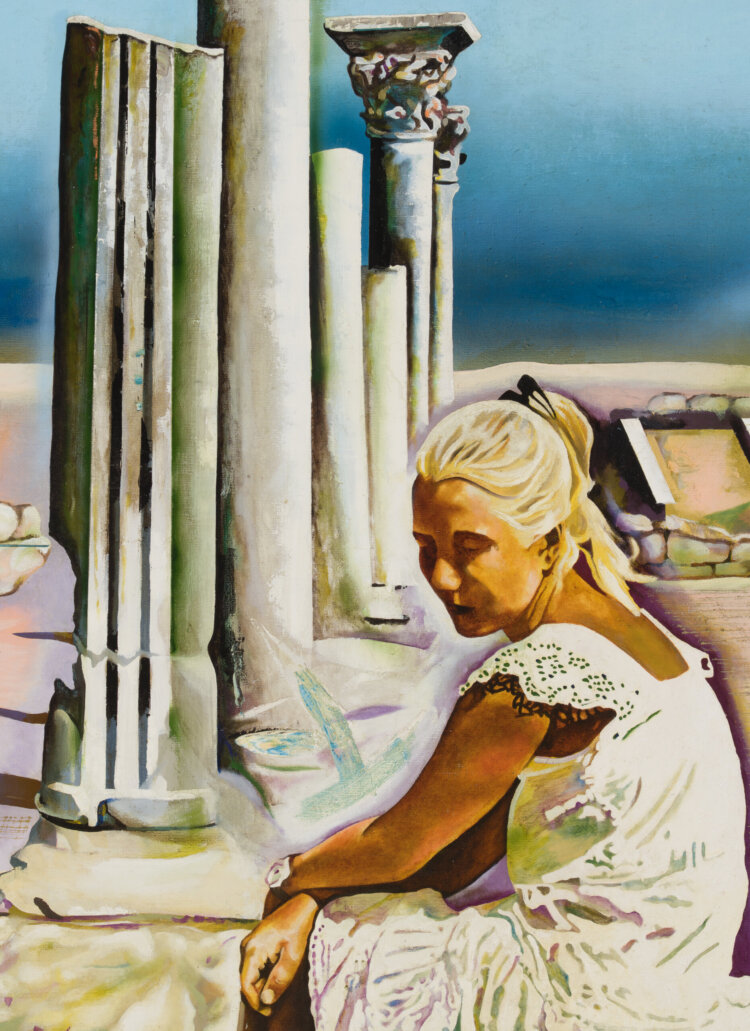
The painting before us, with the artist’s wife Helgi posing in the foreground, is one of the most characteristic and best examples of the style. Depicting a young woman sitting thoughtfully in front of a well-known landmark in Hersonissos, once part of Greece, Polli achieves a metaphysical landscape effect a la de Chirico by masterfully painting a ruined landscape reminiscent of ancient buildings with columns, comparable to Ludmilla Siim’s famous “Portrait of Jaak Kangilaski” (1973). The columns of a Byzantine basilica dating back to the 6th Century are transformed into a metaphysically unearthly form in Polli’s painting, as a shifter of the sense of space, which is amplified by the purple glow surrounding them. Helgi’s white dress also harmonizes with the white columns, reminiscent of a Greek toga, or rather, playing with antiquity in our subconsciousness.
Heitti Polli’s hyperrealistic works belong to the golden fund of Estonian art classics.
Text: Katre Palm, Harry Liivrand